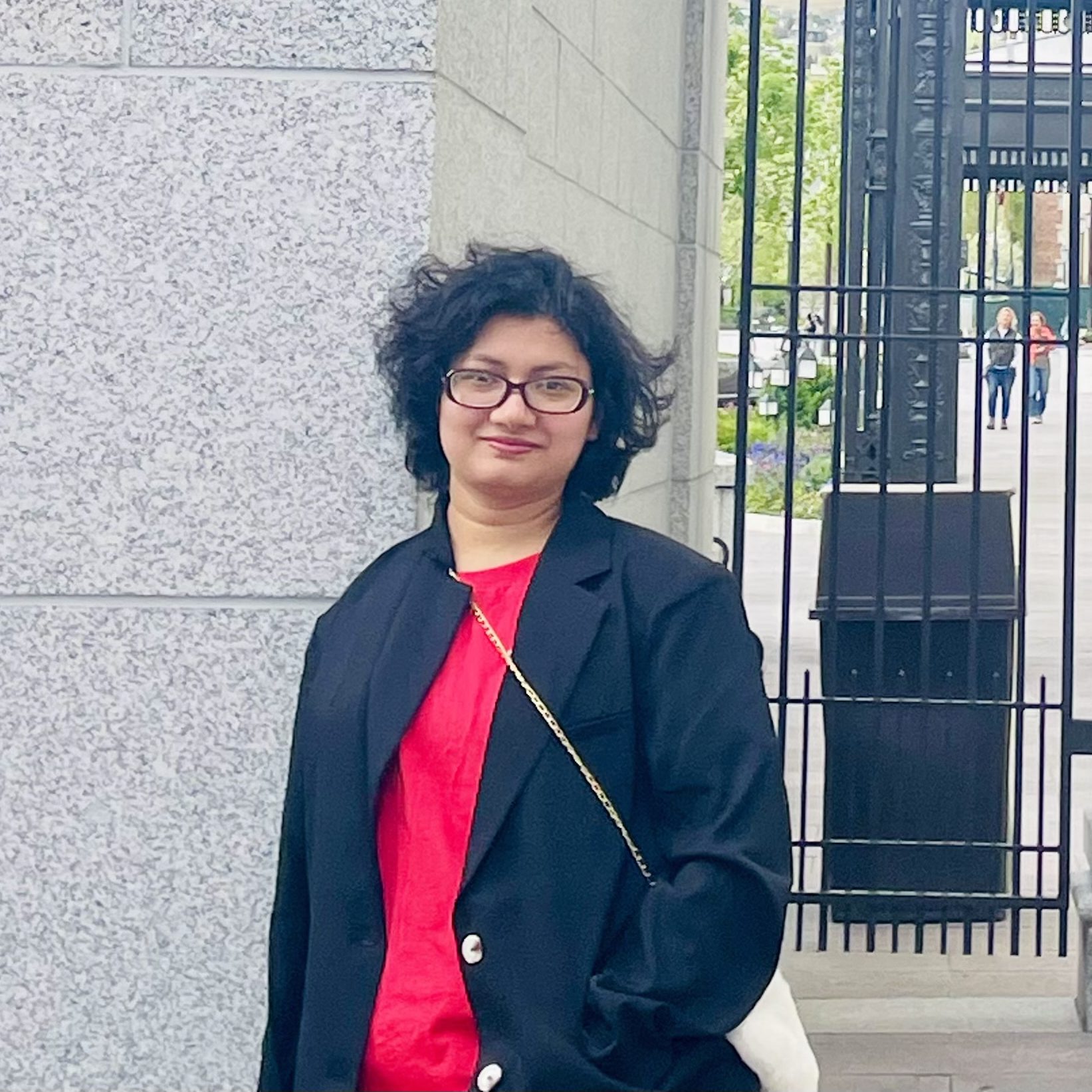
Rumana Rafique
PhD
she / her / hers
Feminist and critical disability studies
Embodied digital practices
Issues of power, inequity, and bias in technologies
Digital and algorithmic literacies
LITR – Literacy Education
Biography
Rumana Rafique (she/her) is a PhD student in the Department of Language and Literacy Education at the University of British Columbia. Her research interests lie at the intersection of feminism, technology, disability, and digital literacies, with a focus on power, inequity, and embodied digital practices. She completed her second master’s in TESOL (Educational Technology) as a Commonwealth Scholar at the University of Manchester, UK. She also holds a master’s in Applied Linguistics and English Language Teaching and a bachelor’s (Honours) in English from the University of Dhaka, Bangladesh. Prior to her doctoral studies, she taught for over a decade at the University of Dhaka, Eastern University, and BRAC University in Bangladesh.
Awards & Honours
Four-Year Fellowships (4YF) for PhD Students, UBC (2026)
R. Howard Webster Foundation Fellowship, Green College, UBC (2025)
President’s Academic Excellence Initiative PhD Award (2025)
Faculty of Education Graduate Award, UBC (2025)
Commonwealth Master’s Scholarship in the UK (2019)
Projects
1. Gulzar, N., & Rafique, R. (2026, March 24–27). The role of critical friendship in technology-enhanced supervision during COVID-19: Lessons from self-study practice [Invited panel presentation]. TESOL Journal: Current Research Highlights (Session), 60th TESOL International Convention and Expo, Salt Lake City, UT, United States.
2. Rafique, R. (2026, March 11). Shadows of the giants: Where to begin and navigating the maze [Invited panel session]. Manchester Institute of Education, University of Manchester, Manchester, United Kingdom.
Selected Publications
1. Gulzar, N., & Rafique, R. (2025). The role of critical friendship in technology‐enhanced supervision during COVID‐19: Lessons from Self‐study practice. TESOL Journal, 16(3), e70064. https://doi.org/10.1002/tesj.70064
2. Rafique, R. (2024). Supporting teachers through online professional development: A small-scale qualitative study with teachers in Bangladesh. Open Learning: The Journal of Open, Distance and e-Learning, 39(2), 112–131. https://doi.org/10.1080/02680513.2024.2316629
3. Palacios, N., Gao, Y., Mourelatou, E., & Rafique, R. (2024). Engaging in online peer-led group reflective practice through the share your research ideas project: Students’ and tutors’ reflective accounts. Reflective Practice, 25(1), 27-39. https://doi.org/10.1080/14623943.2023.2284320
4. Chaudhury, T. A. & Rafique, R. (2024). Effectiveness of English Medium Instruction (EMI) Courses at the Undergraduate Level in the English Department of a Public University. In R. A. Giri, A. Padwad, M. M. N. Kabir (Eds.), English as a Medium of Instruction in South Asia (pp. 190-205). Routledge. DOI: https://doi.org/10.4324/9781003342373
5. Rafique, R. (2023). Using Digital Tools to Enhance Student Engagement in Online Learning: An Action Research Study. In R. Khan, A. Bashir, B. L. Basu & M. E. Uddin (Eds.), Local Research and Glocal Perspectives in English Language Teaching: Teaching in Changing Times (pp. 229-248). Springer. DOI: https://doi.org/10.1007/978-981-19-6458-9_15