Whirlpooling feminist rage: Gang rape-revenge in Foul is Fair and The Nowhere Girls. In Z. Flegar and J. Miskec (Eds), Children’s literature in place: Surveying the landscapes of children’s culture (pp. 88-95). Routledge
Rajagopal, H. (2024)
“Can I speak that यहाँ पे (here)?”: Emergent bilinguals navigating intersectional inequalities with relational multimodal multilingual practices in elementary school. International Multilingual Research Journal, 19 (2), 153-172. https://doi.org/10.1080/19313152.2024.2420158
Rajagopal, H. & Shank Lauwo, M. (2024)
Mapping literacies, mapping selves: Multimodal autobiographical storytelling, critical multilingual awareness and antiracism in teacher education. TESL Canada Journal, 41, (1), 27–53. https://doi.org/10.18806/tesl.v41i1/1398
Schnellert, L., Rajagopal, H., Miller, M. (2024)
“Different Spots in Their Learning Journey”: Striving to Develop Equity-Oriented Teacher Education Pedagogy. In: Burke, J., Cacciattolo, M., Toe, D. (eds) Inclusion and Social Justice in Teacher Education (pp. 317-336). Springer, Cham. https://doi.org/10.1007/978-3-031-67612-3_17
Congratulations to Rachel Horst on successfully defending her dissertation
Please join us in congratulating Rachel Horst on the successful defence of her doctoral dissertation on Tuesday, March 21!
Dissertation title: Writing the Futures Imaginary: Digital Arts-Based Inquiry and the Futures Literacies of Teacher Candidates
The Supervisory Committee:
Supervisors: Dr. Kedrick James and Dr. Leah Macfadyen
Committee Members: Dr. Anthony Paré
The Examiners:
University Examiners: Dr. Anita Sinner (EDCP) and Dr. Derek Gladwin (LLED)
External Examiner: Dr. Jason Wallin (University of Alberta)
The Defense Chair: Dr. Eric Meyers (UBC iSchool)
Congratulations and well done, Rachel!
Zappa-Hollman, S., Ferreira, A. A., Perris, G., Sarmento, S., Matter, M. L., & Baumvol, L. (2024)
Creating a local learner corpus: Insights on project design and data analysis from the pilot phase. In Sarmento, S., Rebechi, R., & Matte, M. L. (Eds.), English for academic purposes: reflections, description and pedagogy, pp. 127-154. Editora Zouk.
Congratulations to Dr. Yuya Takeda
Please join us in congratulating Dr. Yuya Takeda, recently graduated from LLED, on receiving the 2024 Dissertation Award of the Canadian Philosophy of Education Society!
Yuya’s supervisory committee consisted of Dr. Ryuko Kubota (Supervisor), Dr. Kedrick James & Dr. Claudia W Ruitenberg (Committee members).
The title of his dissertation is: “Illuminating (Dis)enlightenment: Critical Media Literacy and/or Conspiracy Theories?”.
Congratulations Yuya, well done!
Abstract:
The point of departure of this dissertation is the striking similarities between the dispositions critical media literacy education aims to cultivate and the characteristics conspiracy theorists claim to embody. The golden question of critical literacy, “who benefits?” is in fact the central question of conspiracy theorists: “cui bono?” While critical media literacy educators teach learners to disrupt the common sense, to interrogate multiple viewpoints, to focus on sociopolitical issues, and to take actions and promote social justice (Lewison et al., 2002), conspiracy theorists claim that they do exactly those things (Harambam, 2020). The question, however, is not demarcating “critical” from “conspiratorial,” but “desirable” from “undesirable” exercises of critical reading and writing. This is because the former demarcation presupposes the undesirability of conspiracy theorizing, the danger of which is evident from the fact that actual conspiracies take place rather frequently in politics and, thus, stigmatization of conspiracy theorizing makes it easier for conspirators to get away with their conspiracies (Pigden, 2007).
To demarcate educationally desirable from undesirable enactments of critical reading and writing, this dissertation embarks on dialectical investigations of analysis, critique, and argument. The analysis part consists of discourse analysis of educational YouTube videos on conspiracy theories. With this, I identify the ways in which conspiracy theories are constructed in educational discourse and highlight the reductive sense of rationality promoted in it. In the critique part, such a reductive sense of rationality is criticized. Through a conceptual examination of meanings, care, and values, I highlight the limitations of the overreliance on scientific objectivity and facts in the discussion of conspiracy theories and claim that literacy education ought to pay attention to the centrality of meanings and values in the textual genre of conspiracy theories. In the argument part, drawing on Robert Brandom’s (1994, 2019) inferentialism with an existentialist spin, I argue for an educational approach that is capable of accounting for conspiracy theories in terms not only of epistemic matters of facts but also of axiological matters of concern. Through this, I offer my answer to the demarcation question and discuss educational implications that arise from it.
LLED Arts-based Research Gathering April 2024
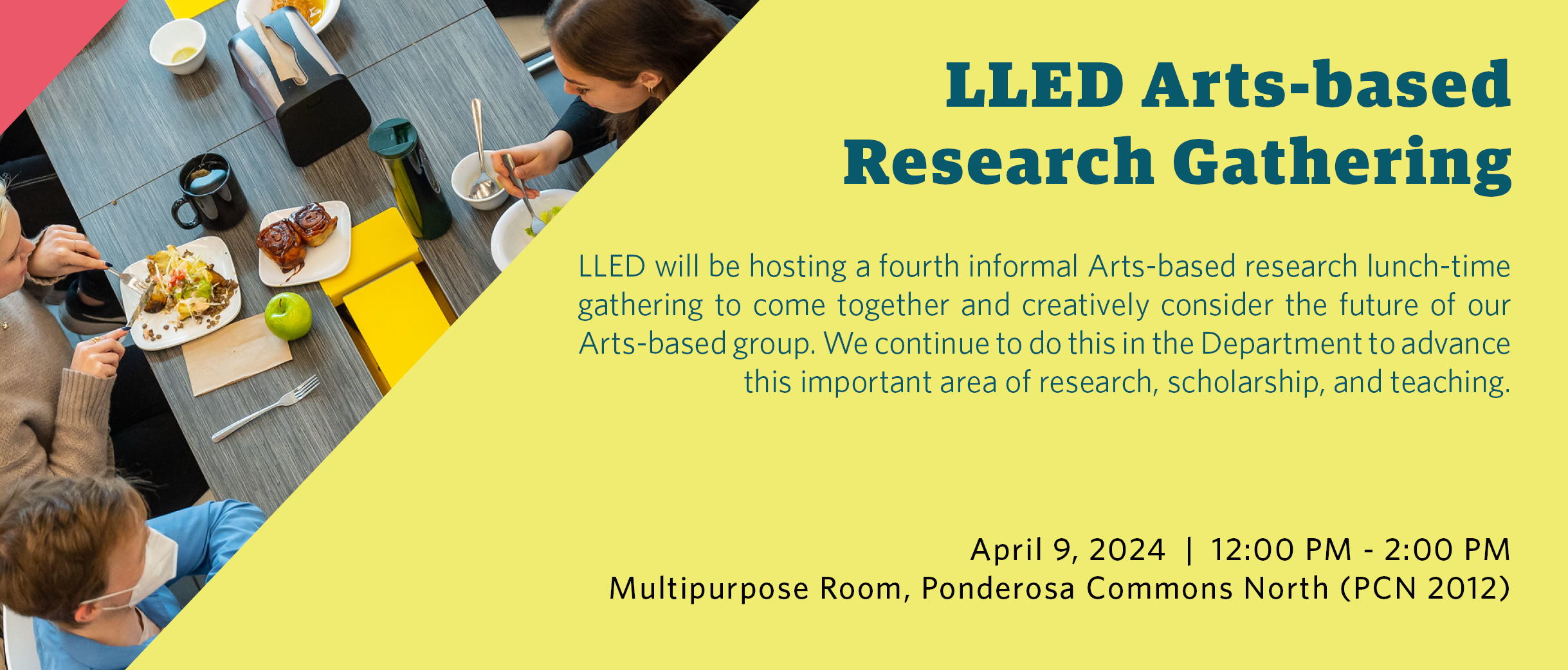
Date: April 9, 2024
Time: 12:00 PM – 2:00 PM
Location: Multipurpose Room, Ponderosa Commons North, PCN 2012
RSVP: https://ubc.ca1.qualtrics.com/jfe/form/SV_9tQ92uARzyNUwiW
LLED will be hosting a fourth informal Arts-based research lunch-time gathering to come together and creatively consider the future of our Arts-based group. We continue to do this in the Department to advance this important area of research, scholarship, and teaching. All faculty, graduate students, and staff are invited to attend regardless of whether you are currently engaged in arts-based research or are just interested and want to experiment with arts-based work, find inspiration, seek collaborations, and so on.
Building off of the exciting artful community building that we engaged with in our March session, those attending on April 9th will be given an opportunity to reflect as well as make wishes for the future of this community – if they so desire. For example, we will be inviting members to consider whether they would be interested in (with the support of Dr. Amber Moore and Dr. Harini Rajagopal) facilitating future sessions (in the fall and beyond) focused on particular arts-based practices.
We look forward to seeing you, reflecting, considering our community’s directions, and planning together.
As an additional note, if you are a current or prospective group member who would prefer for our group to sometimes connect virtually and/or elsewhere, please feel so welcome to get in touch with Amber and Harini.
Online Master of Education in Literacy Education

Online Master of Education in Literacy Education
Program Handbook
Course Objectives
The following graduate seminar provides an overview of the research, theories and practices in literacy education across the lifespan. In the current global landscape, the ways that individuals engage in literacy has shifted beyond just reading and writing. Recognizing a shift in both the linguistic and global landscapes, the ways that scholars conceptualize and understand literacy has changed. Using an inquiry model of teaching, this online course combines opportunities for students to engage in key readings and critical reflection on key topics in literacy education research and practice across the lifespan. It also invites students to engage in personal inquiry.
The topics in this course includes: traditional perspectives in literacy education (such as cognitive/social, early literacy/adolescent literacies) and more contemporary topics (such as multimodality, digital literacies, anti-racism pedagogies).
The following graduate seminar provides an overview of the research, theories and practices in the study of digital media literacies. During this course, students will explore the in and out of school digital literacies practices that students engage in including (but not limited to) artificial intelligence (A.I.), algorithms, Big Data, virtual worlds, social media, makerspace, and reading and writing using digital technologies. Through an autoethnographic experience, students will gain a better understanding of the implications digital literacies has on students’ learning experiences (both in and out of school contexts). The following online course combines opportunities for students to engage in key readings, media and critical reflection. This course invites students to engage in an ongoing personal inquiry to better understand digital literacies.
In this graduate seminar students play active roles as learners/ teachers. The course engages students in exploring and inquiring into how language and literacy are related and interconnected with place, community, history and identities. The course format combines experiential learning, reading and critical reflection on place-based literacies scholarship. Students will have opportunities to use a range of tools and strategies such as arts-based approaches, photography and storytelling to reflect on how they are situated in place. The course centres on how being attentive to place-based literacies supports students to become aware and responsive to issues surrounding ecological and social justice.
Twenty-first Century literacy practices require the ability to “read” and “write” complex texts comprised of multiple modes including linguistic, visual, audial, and gestural. Pedagogical designs must now take into consideration how a range of modalities might contribute to meaning-making alongside and interrelated with, rather than subordinate to, language. In this view, multimodal meaning-making practices in the diverse backgrounds of students must be considered for their educational potential rather than as incidental background to linguistic practices. This interest is broad-based, extends across international borders and linguistic communities. It is driven by more than three decades of research in education, in linguistics and semiotics, and in fields as diverse as internet and communication studies and has led those within the field of language and literacy education to rethink how meaning is made in contemporary classrooms and the world beyond.
Topics in this course include: literacy and multimodality as social practices; New Literacy Studies, multiliteracies, and new literacies; the changing nature of reading and writing; multimodal composing and storytelling; gaming and multimodal learning; power, privilege and bias in education; funds of knowledge; multilingualism; multimodality and ethnography in Literacy Studies; visual analysis and interpretation.
This graduate seminar provides an overview of key literary theories and research studies related to reading and teaching literature for children and adolescents. Using an inquiry model, students will play with selected literary theories and perspectives that have been used to critically analyze literary works and that inform the teaching of literature in schools. These include: reader-response theory, visual/semiotic perspectives, materialisms/cultural studies, feminist and queer theories, postcolonialism, critical race theory, ecocriticism and posthumanism, and methods of spatial analysis. Students have the opportunity to share their own practices as well as to develop new tools for talking about books with children and young adults that broaden our conversations with young people, linking books to their lives and to the world.
In LLED 534, we will examine and question significant issues of innovations, theories, pedagogies, and research related to the teaching of written composition. Grounding the course in a commitment to confront, explore, trouble, and creatively pursue answers and insights to a current conundrum of sorts for us as teachers, we seek to investigate the following questions: What is the purpose of writing in a time of Artificial Intelligence (AI)? What is the purpose of writing pedagogies? And, how might we grow as teachers of writing? To explore such questions, we will especially turn our attention to the generative possibilities of prompt literacy and center processes of creative and expressive writing, including poetry, narrative, and creative non-fiction, for example. The course is organized into three sections where we (1) foreground what we think makes writing ‘good’, (2) consider the pedagogical potential of constraints in writing prompts, and (3) attend to politics and possibilities with/in writing pedagogies (e.g. decolonial approaches, trauma-informed writing, and assessment considerations). The conviction that teachers of writing ought to be writers also underpins this course; as such, it is designed to include frequent opportunities for writing and sharing writing.
As a survey course intended for practitioners in the field of education, EDUC 500 offers a comprehensive overview of the diverse research methods used in the field. It focuses on the practical aspects of designing, conducting, and analyzing educational research that can influence teaching strategies, curriculum development, policy formulation and student outcomes. By introducing various research approaches– their nature, purposes, strengths and limitations, this course aims to equip educational practitioners with the critical skills necessary to interpret research findings, evaluate educational programs, and implement evidence-based practices in their settings.
This course provides early childhood professionals with foundational knowledge in early literacies, including key concepts of “emergent literacy”; historical and contemporary views of literacy acquisition; cognitive, social, and cultural aspects of early literacy; and school and home environments that foster literacy development broadly understood. The theoretical and research literature will provide the basis for exploring implications for early literacy curriculum and instruction with a focus on listening to children’s stories using strengths-based perspectives, recognizing diverse ways of meaning-making, and actively decolonizing understandings of literacy.
The course is a graduate seminar in which participants play active roles as learners/ teachers. Assigned readings and experiences from course participants related to early literacy provide the focus for discussions and reflections. The course format includes discussions and multimodal activities related to the readings; literature circle discussions and small-group student-led presentations related to a key book in the field of early literacy, and an independent assignment related to theory, research, and practice on a specific focus within the field of early literacies.
Students will investigate key literary theories and research studies related to literature for children and adolescents. The focus will be on the use of literary theoretical perspectives that have been used to critically analyze the literary works and to inform the teaching of literary works in schools and other learning contexts. Topics include the application of reader-response theory, semiotic perspectives, materialism/cultural studies, postcolonial theory, feminist theory, critical race theory, queer theories, critical disabilities, ecocriticism, and methods of spatial analysis in the study of children’s and adolescent literature.
The following course is an invitation for Master of Education students to engage in a final graduating project. Students will be provided with an opportunity to engage in a personal inquiry of their choice. They will critically examine the current literature and apply their new knowledge to create a graduating project. Graduating projects will be shared at a Graduate Student Conference at the end of the course.
Congratulations to Giovanna Lucci on being awarded a UBC Killam Graduate Teaching Assistant Award
Please join us in congratulating Giovanna Lucci on being awarded a UBC Killam Graduate Teaching Assistant Award!
In recognition of the valuable role that Graduate Teaching Assistants play in our programs, UBC annually honours GTAs with the Killam Graduate Teaching Assistant Award. Up to 19 winners are selected each spring. Successful candidates have met criteria that demonstrate teaching excellence and a high level of esteem for the candidate from undergraduate students and supervisors. The adjudication for this award takes place within the Faculties.
For a complete list of all Killam GTA award recipients for the year 2023-24, see the awards page here.
Congratulations Giovanna!