So that our languages live on: Indigenous language medium-immersion programs in post-secondary education. In A.V. Brown, C. Crane, B. Dupuy, E. Ene (Eds.) Routledge Handbook of Language Program Development and Administration (pp. 415-426). Routledge
Kumpulainen, K. Renlund, J., Wong, C. C., Byman, J. (2025)
Reimagining digital technologies in environmental education: Relating with the more-than-human world through augmented storying. In B. Ligorio (Ed.), Technology as cultural mediator. Theories and experiences from different contexts (pp. 75-92). Springer Nature. 10.1007/978-3-031-97673-5_4
Toivola, M., Rajala, A., & Kumpulainen, K. (2025)
Teachers’ agency orientations in flipped learning: An ecological perspective. International Journal of Educational Research, 134, 2025, 102837, https://doi.org/10.1016/j.ijer.2025.102837
Pynnönen, L., Kumpulainen, K., & Lipponen, L. (2025)
Parent perspectives on digital play-based early literacy learning in marginalized communities. Journal of Childhood, Education & Society, 6(2), 300-312.
Congratulations to our faculty on their promotions
We are excited to announce that the following four faculty members have been granted promotion effective from July 1, 2025 onwards. Please join us in congratulating them on this important and wonderful achievement!
Dr. Iris Berger has been promoted to the role of Associate Professor of Teaching;
Dr. Meghan Corella has been promoted to the role of Associate Professor;
Dr. Ron Darvin has been promoted to the role of Associate Professor;
Dr. Melanie Wong has been promoted to the role of Associate Professor of Teaching.
Warmest congratulations, Iris, Meghan, Ron and Melanie!
LLED 565A in 2025-26 W1
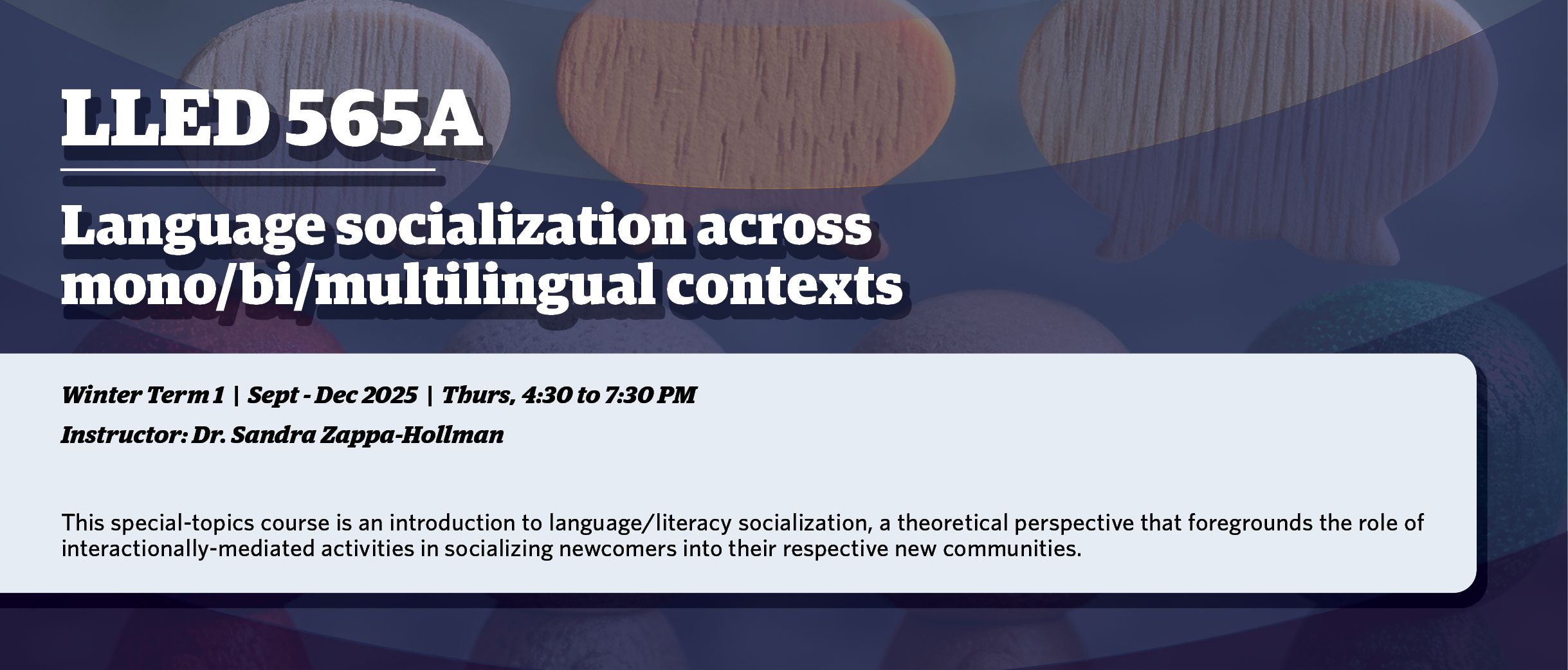
LLED 565A-061 Special Course Subject MTFLD (A)
Topic: Language socialization across mono/bi/multilingual contexts
Winter Term 1 from Sept to Dec 2025
Thursdays, 4:30 to 7:30 PM
Instructor: Dr. Sandra Zappa-Hollman
This special-topics course is an introduction to language/literacy socialization, a theoretical perspective that foregrounds the role of interactionally-mediated activities in socializing newcomers into their respective new communities. Through readings, mini lectures, discussions and a series of in-class and take-home application tasks, you will gain an understanding of the theoretical foundations and methodological issues in language/literacy socialization research across a variety of formal and informal contexts (e.g., home, school, university, the workplace, virtual communities, among others). We examine how language practices connect with cultural knowledge and ideologies, including social roles, identities, and norms, across both local interactions and broader societal contexts (e.g., educational systems and institutional practices; media and pop culture; migration and diaspora experiences; gender norms and relations; language policies). By understanding these complex, unpredictable, multidirectional processes, you will gain insights useful for supporting diverse learners in educational settings and fostering inclusive language and literacy practices, as well as identify the potential relevance of language socialization research to your work.
LLED 442 in 2025-26 W1
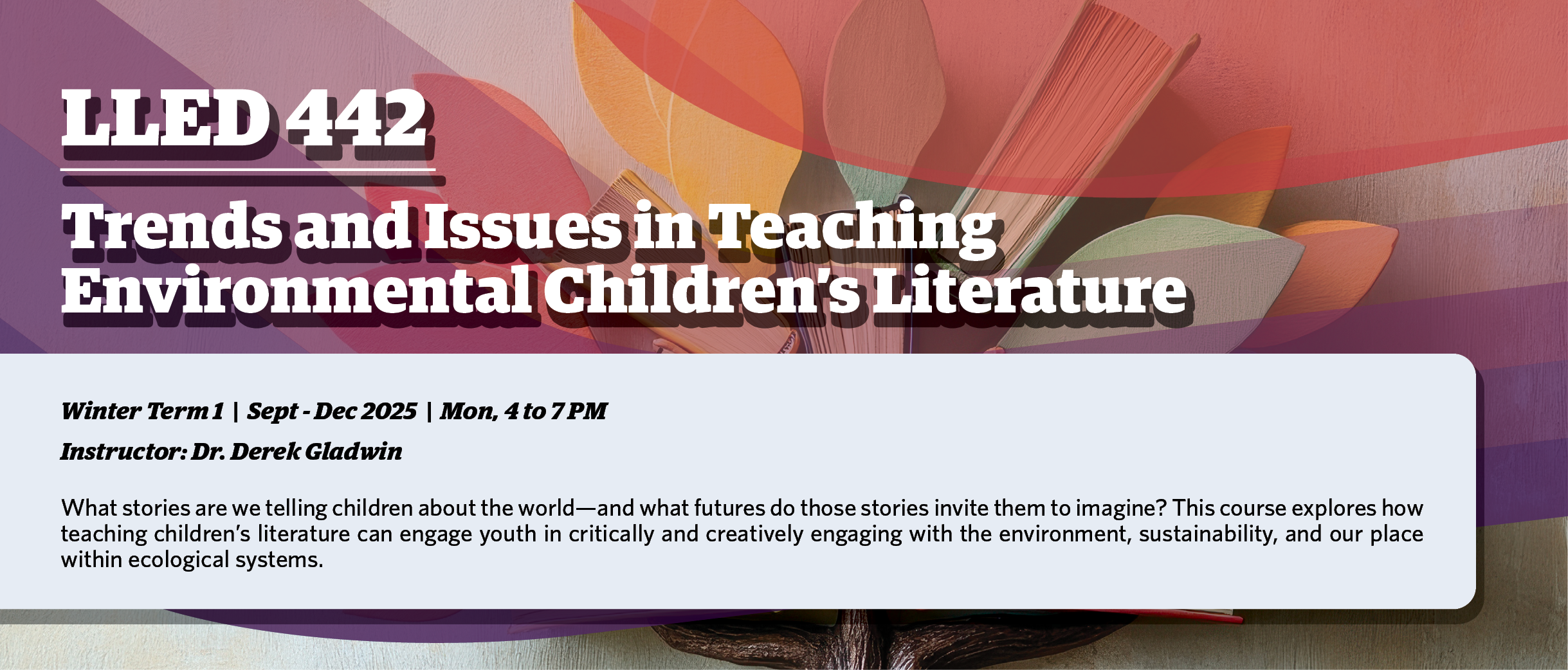
LLED 442: Trends and Issues in Teaching Environmental Children’s Literature
Winter Term 1 from Sept to Dec 2025
Monday, 4 to 7 PM
Instructor: Dr. Derek Gladwin
What stories are we telling children about the world—and what futures do those stories invite them to imagine? This course explores how teaching children’s literature can engage youth in critically and creatively engaging with the environment, sustainability, and our place within ecological systems. Whether you’re an educator, researcher, librarian, creative writer, or simply curious about storytelling’s connection to ecology, this course offers educational tools and perspectives for understanding how stories shape our collective futures. Using a range of Canadian and international texts often taught in K-12 classrooms—from picture books and fairy tales to graphic novels, short stories, film-poems, and young adult fiction—we will examine key ecological and cultural themes including: the Anthropocene and Symbiocene, climate change, waste and pollution, animal and more-than-human perspectives, energy literacy, techno-utopianism, Indigenous storytelling and futurism, and systems thinking. Participants will engage with both critical and practical approaches to children’s literature, combining theory, pedagogy, and creative inquiry. Along the way, we’ll ask: How can stories help children—and ourselves—make sense of today’s environmental challenges? How might they also inspire action, hope, and more just, livable futures?
Note: Open to all disciplines with no prior knowledge necessary, this course can be taken as both undergraduate and graduate and is well suited for teachers, teacher candidates, librarians, researchers, and other interested learners.
*Doherty, L. & Norton, B. (2025)
Navigating “difficult knowledge” in digital stories: Teacher agency, transmediation and translanguaging approaches. Journal of Language and Literacy Education. Spring, 1-18. https://drive.google.com/file/d/1TS05Pw32dwVvijofdfUj78-IMAsJ0wor/view
Rajagopal, H. and Anderson, J. (2025)
“There’s nothing to read here…the newspaper is cho cá, for the fish!”: A Young Refugee-Background Child Brokering Languages, Literacies, and Cultures as a Caring Multiliterate Practice. Reading Research Quarterly, 60: e70018, 1-13. https://doi.org/10.1002/rrq.70018
Belliveau, G. (2025).
Centering art-making in Research-based Theatre: A language and a/r/tographical inquiry. JACE (Journal of Artistic and Creative Education), 17(1). https://jace.online/index.php/jace/article/view/9017