Demystifying the Comps 2025
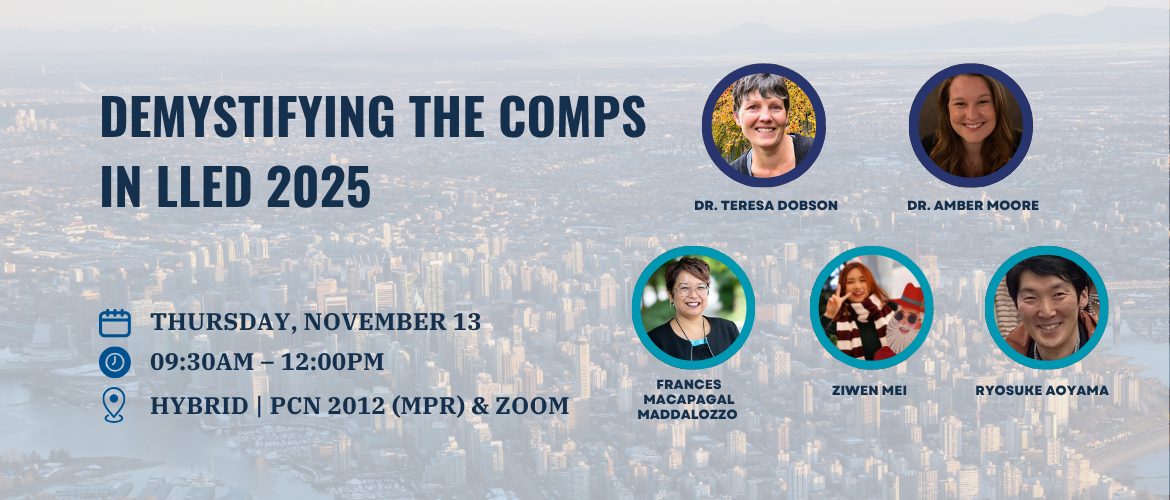
Demystifying the Comps in 2025 in LLED
Presented by the Comps Demystifiers 2025 Team:
Speakers: Dr. Teresa Dobson, Dr. Amber Moore, Ziwen Mei, Frances Macapagal Maddalozzo, Ryosuke Aoyama
Date: November 13, 2025
Time: 9:30AM – 12:00PM
Location: Multipurpose Room (PCN 2012)
About “Demystifying the Comps”
Organized by LLED PhD students in collaboration with the LLED Leadership and Faculty, this initiative is designed to help you better understand the Comps process in our Department and how to navigate this learning-rich yet complex process effectively in your own personal circumstances.
We welcome our fellow LLED PhD students to join and learn with us! Interested LLED Faculty and staff are also welcome to attend the first part of the event, LLED Leadership & Faculty Session & Q&A. Please kindly RSVP for this event to receive the Zoom link and other details.
We look forward to seeing you and sharing our ideas, perspectives, and experiences!
Please contact Masaru Yamamoto (masaru.yamamoto@ubc.ca) if you have any questions.
Schedule
- LLED Leadership & Faculty Session & Q&A (9:30–10:10AM)
- Dr. Teresa Dobson (Graduate Advisor)
- Dr. Amber Moore
- Break (10:10–10:15AM)
- LLED PhD Student Panel & Q&A (10:15–12:00PM) [Student Only]
- Ziwen Mei
- Frances Macapagal Maddalozzo
- Ryosuke Aoyama
Public Talk: Dr. Hazuki Segawa, Kwansei Gakuin University, Japan
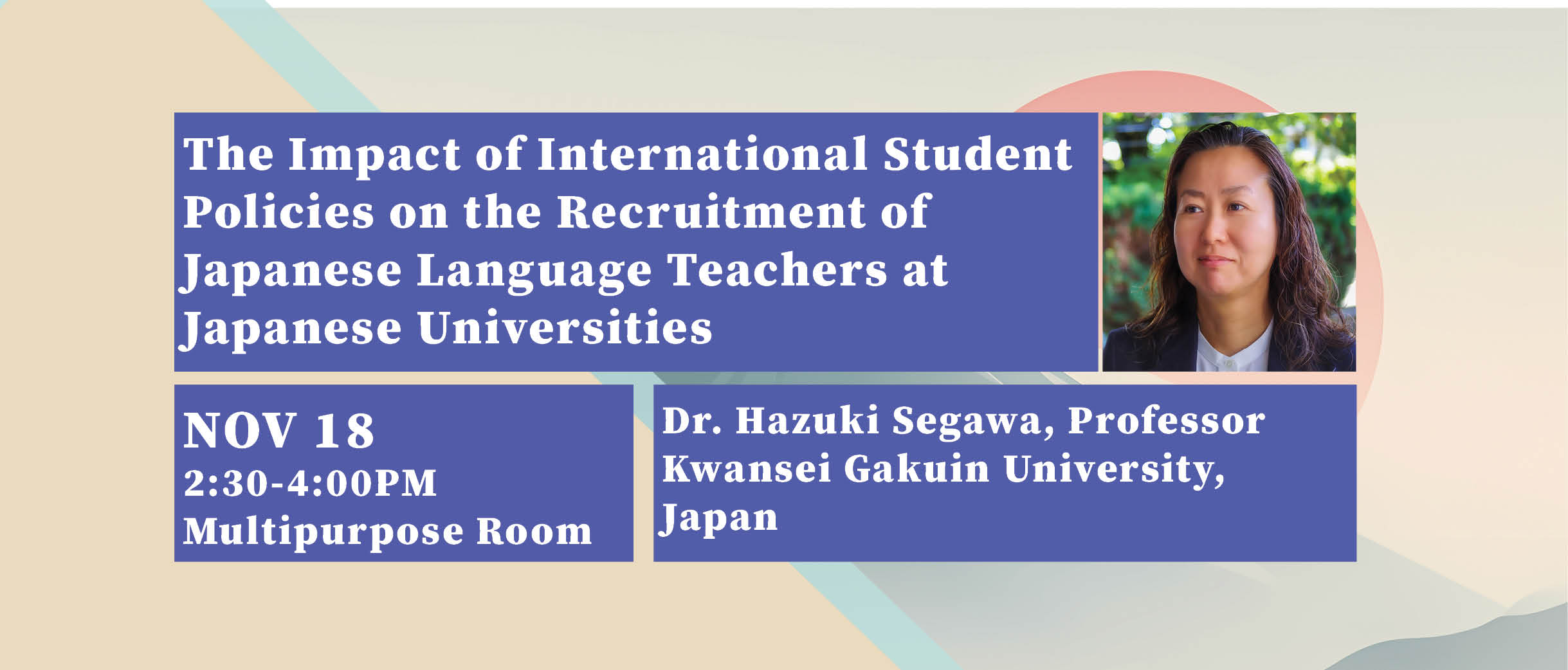
The Impact of International Student Policies on the Recruitment of Japanese Language Teachers at Japanese Universities
Speaker: Dr. Hazuki Segawa, Professor, Kwansei Gakuin University, Japan
Date: November 18, 2025
Time: 2:30 – 4:00 PM PDT
Location: Multipurpose Room (PCN 2012)
Abstract
Japan’s international student policies have resulted in an increase in the number of learners. However, it is important to determine whether this has led to a significant increase in demand for Japanese language teachers. In this lecture, Segawa explores this question by analyzing national survey data from the Agency for Cultural Affairs. Her findings challenge the assumption that an increase in the number of learners necessarily results in greater demand for teachers and call for a deeper policy analysis of the conditions under which teacher recruitment increases. She will also provide an overview of Japan’s current situation regarding immigration policies and Japanese language education policy.
Bio
Hazuki Segawa is a Visiting Scholar in the Department of Language and Literacy Education at the Faculty of Education (UBC). She is a Professor at Kwansei Gakuin University. Her research interests include Japanese language education, language education policy, and plurilingualism. Her primary research book is 戦後日本語教育学とナショナリズ ム: 包摂と差異化の論理 [The relation of Japanese language education studies and nationalism in postwar period: Logics of assimilation and differentiation in ‘Thought pattern discourses’] (2012). She has recently conducted an empirical study on the labor demand for Japanese language teachers during the International Students Enrollment Plans.
Rajagopal, H. (2025)
Remixing images, words, and ideas: Young emergent bilinguals composing remixed countertexts as a creative, relational, and decolonizing practice. Language Awareness, 1–22. https://doi.org/10.1080/09658416.2025.2546594
Darvin, R., & Accurso, K. (2025)
Texts and countertexts: dismantling dominating discourses through decolonizing and antiracist pedagogies. Language Awareness, 1–11. https://doi.org/10.1080/09658416.2025.2567942
Special Issue in Language Awareness

Drs. Ron Darvin & Kathryn Accurso co-editted this special issue in Language Awareness, Vol 34, Issue 2, which looks at how language teachers and students around the world are working to challenge unfair systems in education, especially those rooted in colonialism and racism.
This collaborative issue is titled: “Texts and countertexts: dismantling dominating discourses through decolonizing and antiracist pedagogies“.
Please find the link to the special issue editorial here: https://www.tandfonline.com/doi/full/10.1080/09658416.2025.2567942
LLED 505 in 2025-26 W2

LLED 505: Environmental Literacy
Winter Term 2 from Jan to Apr 2026
Wednesday, 4 to 7 PM
Instructor: Dr. Derek Gladwin
How might we live, learn, and research more ecologically? This course invites researchers, educators, citizens, and leaders to explore literacy and language through an ecological lens—connecting theory, practice, and lived experience. More broadly, it encourages participants to consider what it means to be ecological in everyday practices across disciplines and contexts. Grounded in systems perspectives, complexity, and relational and affective ways of knowing and being, the course challenges dominant Western models of education and research, including individualism, reductionism, and linear thinking. Instead, it centres dynamic, interconnected approaches to how literacy and learning create meaning in our research and in our lives – exploring what being ecological might mean on a planet facing uncertain futures. Organized around action-oriented circular themes—such as Becoming, Composting, Futuring, Listening, Unsettling, and Storying—the course positions literacy as an adaptive, responsive process that can benefit all disciplines. By encouraging the unlearning of dominant systems of knowledge and cultivating relational, regenerative ways of being, the course equips students to envision and contribute to possible ecological futures rooted in connection, repair, and meaningful change.
Kowkabi, N., Yamamoto, M., & Lin, T-Y. (2025)
Harnessing multilingual international students’ English academic socialization through asynchronous interactive online modules. TESL Canada Journal, 42(2), 65–78. https://doi.org/10.18806/tesl.v42i2/1432